Spring Parking Lot Maintenance Checklist for California Businesses
Winter in the Central Valley isn’t brutal, but it’s harder on your parking lot than most property owners realize. A…
CA License #869767
Open Hours: Mon-Fri 8:00AM - 5:00PM

In most cases, yes. Concrete grinding is typically enough to fix a sidewalk trip hazard under ADA when the vertical difference falls within the standard’s height limits. The ADA generally allows a change in level up to 1/4 inch with no treatment, and up to 1/2 inch if it is beveled. Grinding usually brings an offset down into that compliant range.
Where grinding usually falls short is when the displacement is too tall, the panel is cracked through, or the slope of the walkway itself is out of compliance. In those situations, a repair or replacement is generally the right call instead.
For Fresno property owners and managers, this matters because California law typically puts sidewalk upkeep on the abutting owner. As a local concrete grinding provider, Creative Asphalt evaluates each hazard and recommends grinding only when it will actually bring the walk into compliance.
Under the ADA, a vertical change in level greater than 1/4 inch generally counts as a trip hazard that needs treatment. The 2010 ADA Standards set clear height thresholds for walking surfaces.
According to the U.S. Access Board, changes in level on an accessible route are limited by height. These thresholds are what decide whether grinding alone will solve the problem.
| Vertical Change in Level | Required Treatment | Can Grinding Fix It? |
|---|---|---|
| Up to 1/4 inch | None required | Already compliant |
| 1/4 inch to 1/2 inch | Must be beveled at a 1:2 slope | Usually yes, grinding creates the bevel |
| Over 1/2 inch | Must be treated as a ramp | Often no, repair or replacement likely |
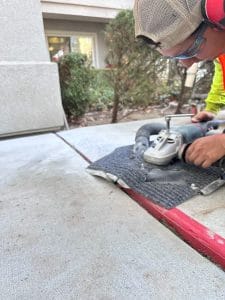
In plain terms, grinding works by shaving the raised edge down into a smooth, beveled transition. When the lift is modest, that bevel satisfies the standard. When the lift is tall, you typically cannot grind enough material away without undermining the slab.
Grinding is generally enough when the trip hazard is a clean vertical offset of roughly 1/2 inch to 1.5 inches with a sound slab underneath. This covers the majority of offsets caused by settling or root lift.
Grinding is also fast and far less disruptive than a pour. There is no cure time, no formwork, and the walkway reopens the same day, which is why it is often the preferred fix for busy Fresno storefronts, HOAs, and healthcare campuses.
Most of these offsets trace back to predictable causes. Our overview of the causes of uneven concrete explains why Central Valley slabs lift in the first place.
Grinding is usually not enough when the offset exceeds roughly 1.5 to 2 inches, the slab is cracked or spalling, or the walkway slope itself violates ADA. Forcing a grind in these cases can create a new hazard instead of removing one.
California’s building standards tend to run stricter than the federal baseline here. The state’s Title 24 (Chapter 11B), enforced by the Division of the State Architect, holds commercial walkways to slope and surface rules that sometimes exceed the federal ADA minimums, so a borderline grind may pass federally yet fail a California inspection.
When replacement is the answer, weighing a patch against a full pour matters. Our take on asphalt overlay vs replacement applies the same logic to pavement decisions.
In California, the abutting property owner is generally responsible for maintaining the sidewalk fronting their property. This is a key reason Fresno businesses and HOAs take trip hazards seriously.
California Streets and Highways Code Section 5610 requires owners to keep the fronting sidewalk in a condition that does not endanger people or property. While a maintenance duty does not automatically create injury liability, many California cities have adopted ordinances that shift that liability to the owner, and owners are generally liable when they created the hazard, such as through landscaping or tree roots.
For a business, a non-compliant walk is both an injury-claim risk and an ADA exposure. A visible trip hazard at a Fresno entrance is easy for a visitor to document, which makes prompt, correct repair the smart move. Folding sidewalk checks into a broader commercial parking lot maintenance routine keeps these issues from piling up.
We assess each hazard against ADA height and slope limits first, then recommend grinding only when it will truly bring the walkway into compliance.
Thinking about handling a small offset yourself? Read our honest look at DIY concrete grinding first, then contact us for a professional assessment of your Fresno property.
How tall a trip hazard can concrete grinding fix?
Grinding can typically handle a vertical offset up to roughly 1.5 inches, sometimes 2 inches on a thick, sound slab. Beyond that, grinding away enough concrete usually risks thinning the slab, so replacement generally becomes the safer, longer-lasting fix.
Does concrete grinding leave the sidewalk looking damaged?
No. Professional grinding leaves a smooth, uniform transition that blends into the surrounding surface. The ground area may look slightly lighter at first, but it usually weathers to match the rest of the walkway within a few weeks.
How long does a ground trip hazard stay ADA compliant?
When the slab is sound and the soil beneath has stopped settling, a ground transition generally stays compliant for many years. If an active tree root or ongoing soil movement caused the lift, the offset can return, which is why we check the cause before grinding.
Is grinding cheaper than replacing the sidewalk panel?
In most cases, yes. Grinding usually costs a fraction of a full panel replacement because there is no demolition, no new concrete, and no cure time. For a sound slab with a modest offset, it is typically the most cost-effective compliant fix.
Does grinding fix a sidewalk that slopes the wrong way?
Usually not. Grinding removes a raised edge, but it cannot re-pitch an entire panel that exceeds the ADA cross-slope limit of 1:48. A walkway that slopes too steeply generally needs the panel re-poured to the correct grade.